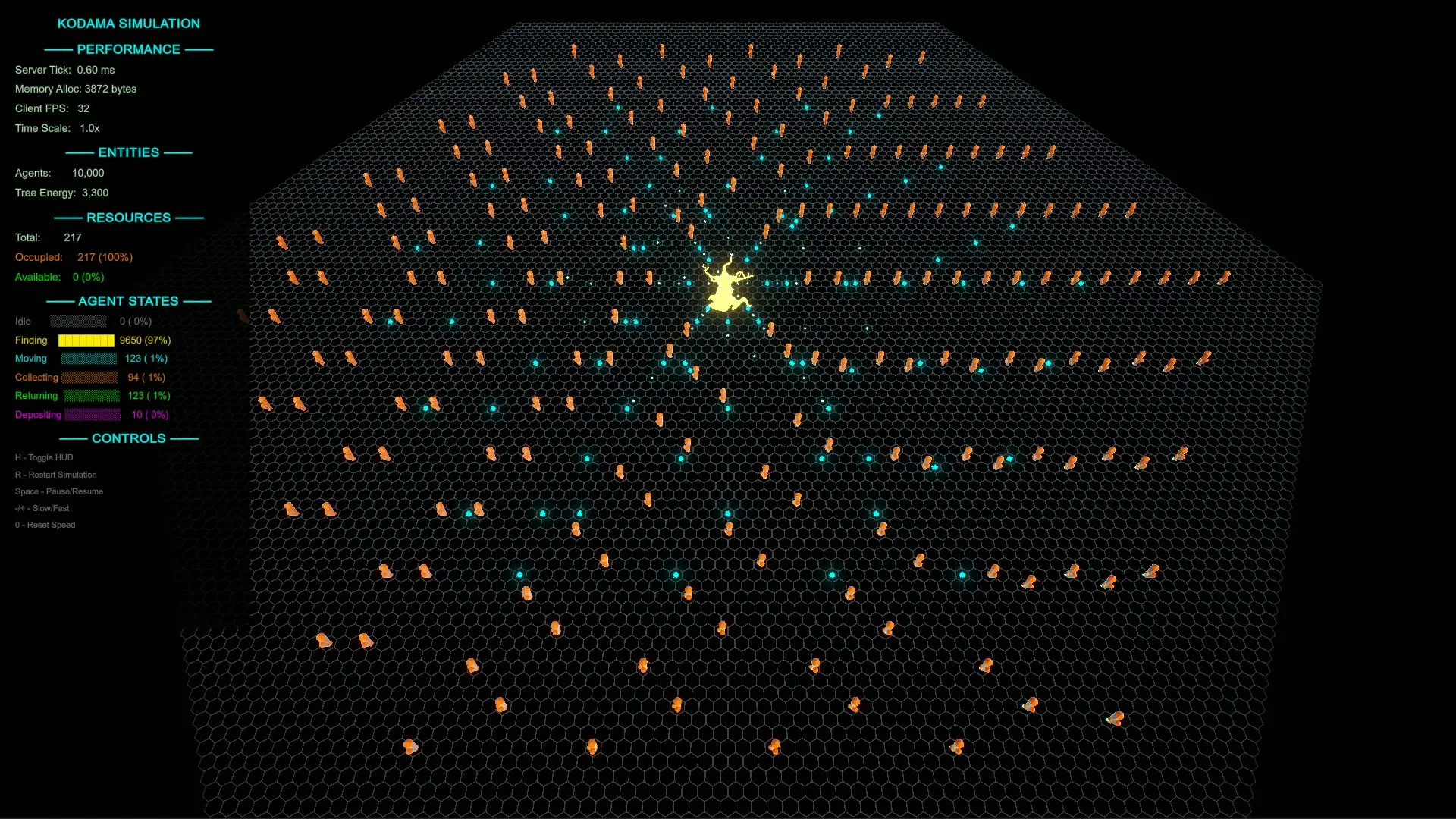
Kodama
Context
Kodama is an end-to-end distributed simulation prototype — not a shipping product, but a deliberate sandbox for stress-testing patterns at scale. The problem I wanted to solve: crowded interactive worlds strain the server loop, the wire format, and the client frame budget all at once. I needed a stack where I could measure each constraint separately.
Decision
I chose SignalR with binary snapshots over a custom WebSocket gateway. The tradeoff was higher initial payload size in exchange for simpler operational maintenance — one less bespoke component in the critical path. The server's hot path runs on data-oriented storage: a sparse-set, structure-of-arrays agent store (ECS-style parallel arrays with per-state dense sets) and a position-hashed spatial index for O(1) cell lookups — plus struct DTOs, custom enumerators, and buffer pooling; no LINQ in simulation code. On the client, GPU instancing handles crowd rendering without per-entity draw calls. Nearest-resource search is still a linear scan — profiled as a non-bottleneck at 10K agents, and I keep it visible as acknowledged debt rather than pretending it is solved.
Outcome
10K+ agents with sub-millisecond behaviour pass ticks, zero-allocation behaviour updates, and ~70% smaller payloads versus comparable JSON snapshots.